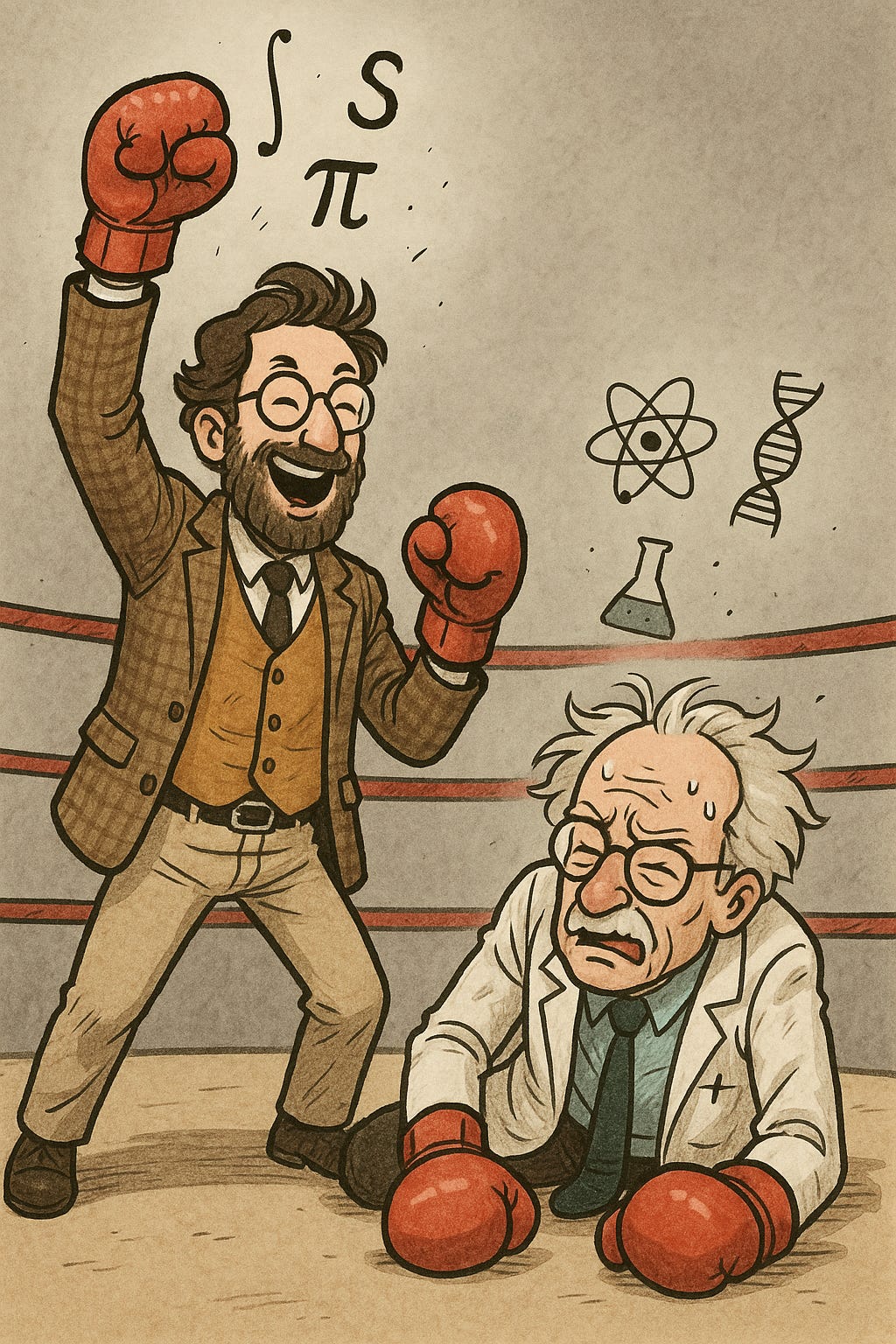
Math > Science
I wish I knew this earlier

Science rarely speaks in “proof” the way math does. Which makes science some kind of horrifying cacodemonic monotheistic religion. Why does anybody even use science or wear those stupid t-shirts about how much they “love science”? Ugh. No wonder science is co-opted by all of the usual suspects. Math is so much better. Math is superior to science in every way.
20 crisp contrasts: how math speaks in proof vs how science speaks
Short, punchy comparisons — each item gives the math-style statement first, then the scientific-style counterpart.
Certainty vs. Probability
Math: A proved theorem is true (given the axioms).
Science: A hypothesis is supported with a probability or confidence interval.Deduction vs. Induction
Math: Conclusions follow deductively from definitions and axioms.
Science: Conclusions are inferred inductively from observations and experiments.Axioms as ground truth vs. Empirical premises
Math: You accept axioms and derive consequences.
Science: You start from measurements and revise ideas if new data disagree.Universal necessity vs. Provisional generalization
Math: A proof says “always” (for all cases covered by assumptions).
Science: Statements are usually “as far as we know” or “with current evidence.”Single airtight chain vs. multiple supporting lines
Math: One valid proof suffices.
Science: Multiple independent experiments strengthen belief.Exactness vs. Approximation
Math: Results are exact (2 + 2 = 4).
Science: Results typically have error bars, approximations, and measurement noise.Context-free truth vs. Context-dependent truth
Math: Theorem truth depends only on logical form and axioms.
Science: Findings can depend on conditions (temperature, population, apparatus).Proof permanence vs. Theory revision
Math: A proved theorem stays proved barring change of axioms.
Science: Theories are updated or replaced when new evidence appears.Internal consistency vs. Empirical adequacy
Math: What matters is logical consistency.
Science: What matters is how well a model matches observed phenomena.Counterexample kills the statement vs. Counterevidence weakens support
Math: One counterexample disproves a universal theorem.
Science: One anomalous datum raises questions but rarely overturns a robust theory alone.No reliance on instruments vs. reliance on instruments
Math: Proofs need only a brain and symbols.
Science: Experiments require instruments; conclusions depend on their accuracy.Proofs are constructive/analytic vs. models are explanatory/predictive
Math: A proof shows why a statement follows.
Science: A model both explains and predicts, subject to empirical test.Binary truth-value vs. graded belief
Math: Statement is true or false (within system).
Science: Statements have degrees of confidence and uncertainty.A single referee can accept a proof vs. community and replication matter
Math: Peer scrutiny is important, but a correct proof stands.
Science: Replication and independent confirmation are central to acceptance.Transparency of reasoning vs. messy data interpretation
Math: Logical steps are explicit and checkable.
Science: Data analysis can involve choices (filters, models) that affect conclusions.No experimental variability vs. natural variability
Math: No randomness unless built into the axioms (probability theory).
Science: Natural systems have variability that must be modeled statistically.Proof shows logical necessity of consequences vs. experiment shows causal/associative relations
Math: “If A then B” follows inevitably.
Science: “A is associated with B” — establishing causation requires careful design.Scope defined by assumptions vs. scope discovered by testing
Math: Theorems specify exactly where they apply.
Science: Applicability is often discovered gradually by trying different cases.Falsifiability isn’t the point vs. falsifiability is essential
Math: You don’t “falsify” a proof; you find mistakes or counterexamples.
Science: A good scientific hypothesis must in principle be falsifiable by observation.Proofs don’t need probabilities vs. science quantifies uncertainty
Math: Probability can be formalized, but many proofs are non-probabilistic.
Science: Nearly every empirical claim includes probabilistic statements (p-values, CIs).